Please note that the auto-translation function (beta) uses the 3rd-party tool to translate contents based on the English version of the website and it may occur incorrect results sometimes.
x

2027·4·13 - 16
Shenzhen World Exhibition & Convention Center (Bao'an), PR China

Quick Links:
Top Search Exhibitor
Market News
Flying High in the Trillion-Dollar Low-Altitude Economy Racetrack
Publish date: 2026-01-16
Low-altitude airspace is emerging as a gateway to the new economy.
From tackling “last-mile” delivery challenges to enhancing agricultural production, and from logistics in mountainous regions to urban commuting, low-altitude flying vehicles are increasingly integrated into both industrial operations and everyday life.
How booming is the low-altitude economy?
The Civil Aviation Administration of China projects that by 2035, the value of domestic low-altitude economy market is expected to reach RMB 3.5 trillion, creating a comprehensive industry chain that includes R&D, manufacturing, and operations. A recently released index report indicates that by the end of 2024, the number of related enterprises nationwide reached 14,707, reflecting a year-on-year increase of 19.8%, significantly outpacing the average growth rate in the past three years.
The rapid development of the low-altitude economy requires flying vehicles to operate safely while also achieving longer flight ranges. In this context, plastics and composite materials are emerging as strategically valuable resources for low-altitude flying vehicles due to their lightweight properties, high strength, excellent weather resistance, fatigue resistance, and superior chemical durability.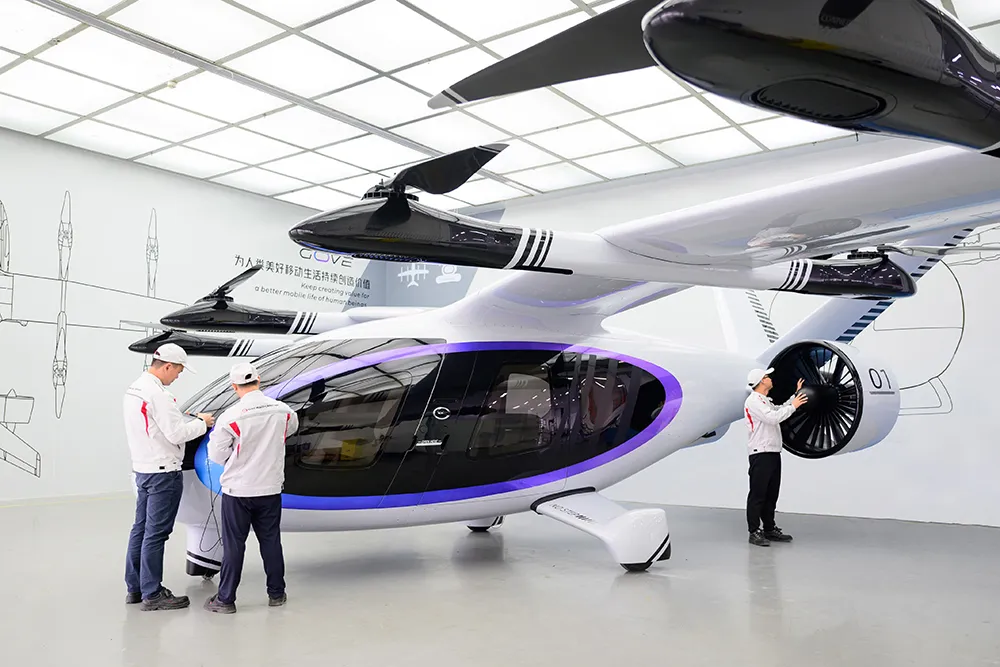
Which components of low-altitude flying vehicles use plastics and composites?
Currently, plastics and composite materials are primarily used in the following structural components of low-altitude flying vehicles:
Load-Bearing Structures: Carbon fiber and glass fiber composites are utilized for wings, wing beams, and load-bearing skins. Thermoplastic composites, such as modified PA and PEEK, are increasingly favored for manufacturing load-bearing and connecting parts.
Interior Components: Lightweight structures with flame resistance and weather durability are designed for seat frames, interior panels, dashboard brackets, and cable sheaths.
Battery and Thermal Management: Battery casings, thermal interface materials, thermally conductive plastics, and fire-resistant layers are essential for ensuring high safety and extending flight range.
Specialty Parts: Propellers and housings for sensors and lenses which require high rigidity and dimensional stability.
Which materials and forming processes enhance safety and durability?
The diverse and complex material requirements present three key challenges for manufacturers in the commercialization of low-altitude flying vehicles:
1. Safety: The primary requirement and regulatory baseline
Low-altitude flying vehicles must achieve a balance among various indicators, including flame resistance, low smoke emissions, toxicity, fatigue resistance, and impact resistance. This is especially critical in areas surrounding the battery compartment, where stricter requirements for temperature resistance, fire protection, and thermal insulation are essential to maintain structural integrity even in extreme situations such as thermal runaway.
In terms of material selection, the industry commonly utilizes general engineering plastics like PA, PC, POM, PPO, and thermoplastic polyesters to meet the flame resistance and stability requirements for standard structural components. For high-temperature zones and key protective areas, specialty engineering plastics like PPS, PEEK, and PI, which can withstand temperatures above 150°C, are employed to provide enhanced heat resistance, flame retardancy, and long-term reliability.
Covestro’s high CTI polycarbonate offers reliable performance and safety in demanding electrical environments, ensuring stable operation for electric vertical takeoff and landing vehicles (eVTOLs). In battery encapsulation applications, these materials demonstrate excellent flame retardancy and thermal stability, which are crucial for preventing overheating and ensuring consistent performance.
KingPan® composite panels from Kingfa Sci.&Tech. are engineered using continuous fibers combined with various resin matrices, including PP, PE, ABS, and PA. These panels boast a high glass fiber content and achieve V-0 flame retardancy. They can withstand temperatures of up to 1,200°C and endure continuous burning for 30 minutes without dripping. Additionally, they self-extinguish within 10 seconds of being removed from a flame.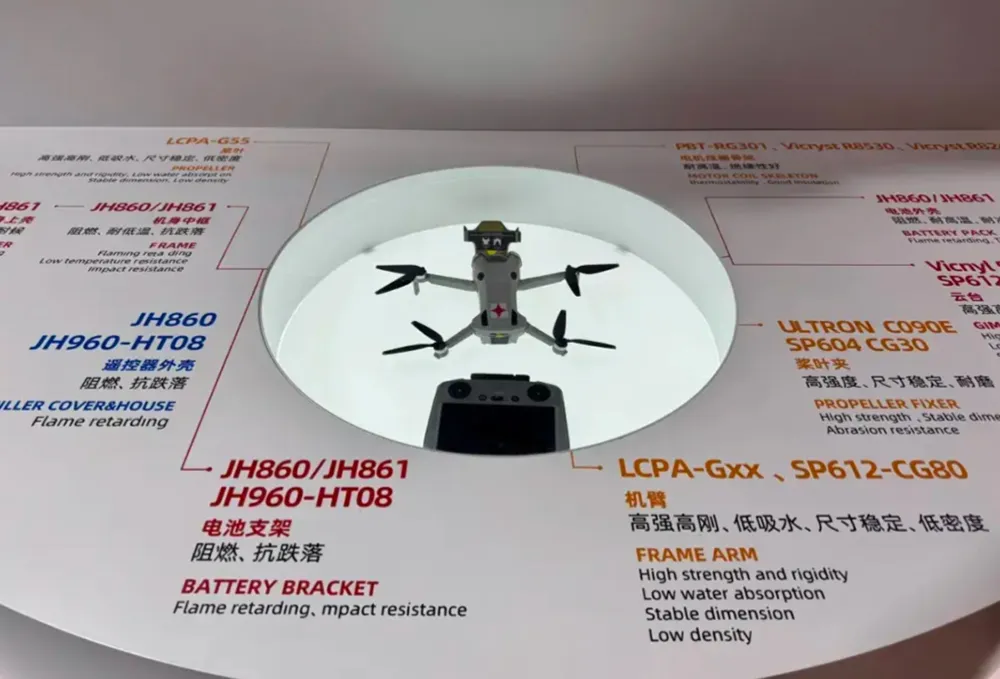
PPS materials from Suzhou NAPO Advanced Material Technology are capable of sustained use at temperatures up to 220°C, with short-term resistance reaching 260°C. They also achieve a flame retardancy rating of UL94 V-0, making them suitable for core components such as structural parts of drone bodies, battery mounts, and motor housings, as well as connectors in eVTOLs.
2. Endurance: Directly influencing commercial efficiency
Lightweighting is a measurable and consistently effective solution for enhancing endurance. Reducing structural weight by just 1 kg can lead to significant improvement in flight range, flight time, and payload capacity. Composite materials and high-performance engineering plastics play crucial roles in achieving these weight reductions.
The GOVY AirJet, the first composite-wing flying vehicle developed by GAC, utilizes carbon fiber composite materials for over 90% of its components. This approach not only reduces the overall weight of the vehicle but also enhances its structural strength.
Nanjing Julong Science & Technology’s carbon fiber composites and PEEK materials have also found applications in the drone sector. The company has developed manufacturing capabilities for engine nacelles, housings, load-bearing layers, fuselage covers, sound-transparent panels, composite skirts, and various other drone components and assemblies, as well as drone base station equipment.
Arkema's Rilsan® PA11 material is suitable for producing structural components and exterior parts for eVTOLs, thanks to its lightweight, high strength, excellent surface finish, low warpage, superior processability, and 100% recyclability. This bio-based polyamide is sourced entirely from renewable castor beans, with glass fiber reinforced grades featuring glass fiber content ranging from 23% to 65%.
Wanhua Chemical’s WanBlend® silicone-PC materials contribute to weight reduction in flying vehicles as well. With a density of only 1.15-1.2 g/cm³, these materials are lighter than traditional alternatives. The weight saved by incorporating them into the airframe is equivalent to that of a large-capacity battery, significantly enhancing the vehicle’s flight range.
3. Cost saving: A key to scalable commercialization
Transitioning from prototypes to mass production requires not only advanced materials but also automation in manufacturing processes. High-speed forming and processing can significantly lower unit manufacturing costs and shorten the time to market for low-altitude flying vehicles.
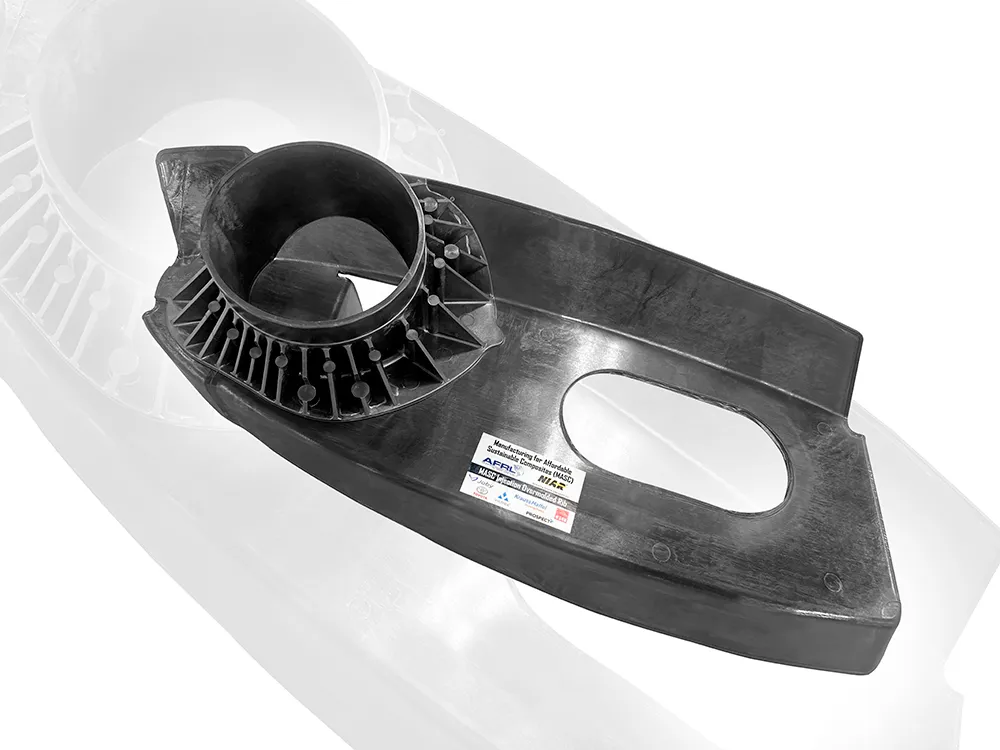
KraussMaffei’s FiberForm technology integrates the thermal pressing of continuous fiber organic sheets with secondary injection molding. In contrast to traditional metal rib structures, which require over 100 hours for processing, this innovative method reduces manufacturing time to approximately 2 minutes while maintaining equivalent structural strength and safety performance. This technology has already been applied in the manufacturing of low-altitude flying vehicles.
Additionally, 3D printing represents another significant advancement in the production of low-altitude flying vehicles. By leveraging topology optimization and lattice structures, it can easily create complex designs such as integrated cooling channels and hollow, thin-walled components, which have been challenging to produce using conventional methods.
3D printing also shortens prototype development cycles from months to just days, accelerating research and development for low-altitude flying vehicles. It enables rapid customization of specialty parts, such as pods and sensor brackets, to meet diverse needs in areas like surveying, inspection, and emergency response.
Stratasys leverages high-performance engineering materials, such as ULTEM™ 9085 and Antero 840CN03, along with industrial-grade FDM® and SAF® technologies, to manufacture lightweight, high-strength structural components tailored for demanding flight environments. This provides robust engineering solutions for drones and eVTOLs.
How can plastics enterprises capitalize on opportunities?
In the low-altitude economy racetrack, opportunities and challenges coexist. While the continuous expansion of the industry and a more refined product ecosystem are steadily enhancing market vitality, core issues such as technological innovation and infrastructure development require ongoing efforts from the entire industry.
To seize these market opportunities, plastics enterprises should focus on three key areas:
1. Transform from suppliers to solution providers
Companies must go beyond merely selling raw materials. Understanding manufacturers' needs and offering integrated material solutions that address safety, endurance, and cost efficiency are essential.
2. Focus on collaborative processing innovation
Close collaboration with equipment manufacturers and component suppliers is vital. Developing specialty materials that are suitable for high-speed mass production, such as integrated molding, as well as for rapid customization, like 3D printing, can significantly reduce overall manufacturing cost through a “material-process” approach.
3. Meet standards and certifications
As material standards for low-altitude flying vehicles have become increasingly stringent, actively participating in industry standards development and ensuring that products meet relevant aviation certifications are crucial for building long-term competitive advantages.
Notably, only those enterprises that can harness material innovation to achieve weight reduction, enhanced safety, and cost efficiency will fly high in this new trillion-dollar racetrack.
From tackling “last-mile” delivery challenges to enhancing agricultural production, and from logistics in mountainous regions to urban commuting, low-altitude flying vehicles are increasingly integrated into both industrial operations and everyday life.
How booming is the low-altitude economy?
The Civil Aviation Administration of China projects that by 2035, the value of domestic low-altitude economy market is expected to reach RMB 3.5 trillion, creating a comprehensive industry chain that includes R&D, manufacturing, and operations. A recently released index report indicates that by the end of 2024, the number of related enterprises nationwide reached 14,707, reflecting a year-on-year increase of 19.8%, significantly outpacing the average growth rate in the past three years.
The rapid development of the low-altitude economy requires flying vehicles to operate safely while also achieving longer flight ranges. In this context, plastics and composite materials are emerging as strategically valuable resources for low-altitude flying vehicles due to their lightweight properties, high strength, excellent weather resistance, fatigue resistance, and superior chemical durability.
Covestro and GAC collaborate to bring flying cars closer to reality. (Photo: GAC)
Which components of low-altitude flying vehicles use plastics and composites?
Currently, plastics and composite materials are primarily used in the following structural components of low-altitude flying vehicles:
Load-Bearing Structures: Carbon fiber and glass fiber composites are utilized for wings, wing beams, and load-bearing skins. Thermoplastic composites, such as modified PA and PEEK, are increasingly favored for manufacturing load-bearing and connecting parts.
Interior Components: Lightweight structures with flame resistance and weather durability are designed for seat frames, interior panels, dashboard brackets, and cable sheaths.
Battery and Thermal Management: Battery casings, thermal interface materials, thermally conductive plastics, and fire-resistant layers are essential for ensuring high safety and extending flight range.
Specialty Parts: Propellers and housings for sensors and lenses which require high rigidity and dimensional stability.
Which materials and forming processes enhance safety and durability?
The diverse and complex material requirements present three key challenges for manufacturers in the commercialization of low-altitude flying vehicles:
1. Safety: The primary requirement and regulatory baseline
Low-altitude flying vehicles must achieve a balance among various indicators, including flame resistance, low smoke emissions, toxicity, fatigue resistance, and impact resistance. This is especially critical in areas surrounding the battery compartment, where stricter requirements for temperature resistance, fire protection, and thermal insulation are essential to maintain structural integrity even in extreme situations such as thermal runaway.
In terms of material selection, the industry commonly utilizes general engineering plastics like PA, PC, POM, PPO, and thermoplastic polyesters to meet the flame resistance and stability requirements for standard structural components. For high-temperature zones and key protective areas, specialty engineering plastics like PPS, PEEK, and PI, which can withstand temperatures above 150°C, are employed to provide enhanced heat resistance, flame retardancy, and long-term reliability.
Covestro’s high CTI polycarbonate offers reliable performance and safety in demanding electrical environments, ensuring stable operation for electric vertical takeoff and landing vehicles (eVTOLs). In battery encapsulation applications, these materials demonstrate excellent flame retardancy and thermal stability, which are crucial for preventing overheating and ensuring consistent performance.
KingPan® composite panels from Kingfa Sci.&Tech. are engineered using continuous fibers combined with various resin matrices, including PP, PE, ABS, and PA. These panels boast a high glass fiber content and achieve V-0 flame retardancy. They can withstand temperatures of up to 1,200°C and endure continuous burning for 30 minutes without dripping. Additionally, they self-extinguish within 10 seconds of being removed from a flame.
Kingfa’s materials are suitable for use in components of low-altitude flying vehicles.
PPS materials from Suzhou NAPO Advanced Material Technology are capable of sustained use at temperatures up to 220°C, with short-term resistance reaching 260°C. They also achieve a flame retardancy rating of UL94 V-0, making them suitable for core components such as structural parts of drone bodies, battery mounts, and motor housings, as well as connectors in eVTOLs.
2. Endurance: Directly influencing commercial efficiency
Lightweighting is a measurable and consistently effective solution for enhancing endurance. Reducing structural weight by just 1 kg can lead to significant improvement in flight range, flight time, and payload capacity. Composite materials and high-performance engineering plastics play crucial roles in achieving these weight reductions.
The GOVY AirJet, the first composite-wing flying vehicle developed by GAC, utilizes carbon fiber composite materials for over 90% of its components. This approach not only reduces the overall weight of the vehicle but also enhances its structural strength.
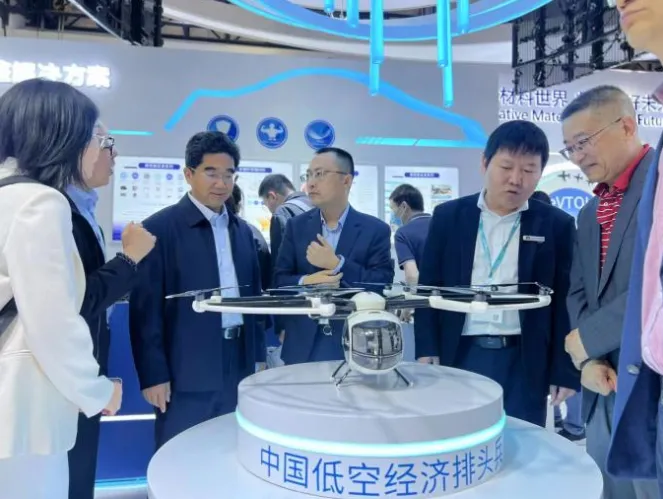
Nanjing Julong Science & Technology’s carbon fiber composites and PEEK materials have also found applications in the drone sector. The company has developed manufacturing capabilities for engine nacelles, housings, load-bearing layers, fuselage covers, sound-transparent panels, composite skirts, and various other drone components and assemblies, as well as drone base station equipment.
Nanjing Julong showcased its low-altitude economy material solutions at CHINAPLAS 2025.
(Photo: Nanjing Julong)
(Photo: Nanjing Julong)
Arkema's Rilsan® PA11 material is suitable for producing structural components and exterior parts for eVTOLs, thanks to its lightweight, high strength, excellent surface finish, low warpage, superior processability, and 100% recyclability. This bio-based polyamide is sourced entirely from renewable castor beans, with glass fiber reinforced grades featuring glass fiber content ranging from 23% to 65%.
Wanhua Chemical’s WanBlend® silicone-PC materials contribute to weight reduction in flying vehicles as well. With a density of only 1.15-1.2 g/cm³, these materials are lighter than traditional alternatives. The weight saved by incorporating them into the airframe is equivalent to that of a large-capacity battery, significantly enhancing the vehicle’s flight range.
3. Cost saving: A key to scalable commercialization
Transitioning from prototypes to mass production requires not only advanced materials but also automation in manufacturing processes. High-speed forming and processing can significantly lower unit manufacturing costs and shorten the time to market for low-altitude flying vehicles.
KraussMaffei’s FiberForm technology integrates the thermal pressing of continuous fiber organic sheets with secondary injection molding. In contrast to traditional metal rib structures, which require over 100 hours for processing, this innovative method reduces manufacturing time to approximately 2 minutes while maintaining equivalent structural strength and safety performance. This technology has already been applied in the manufacturing of low-altitude flying vehicles.
The FiberForm-manufactured structural component with a highly complex rib structure. (Photo: KraussMaffei)
Additionally, 3D printing represents another significant advancement in the production of low-altitude flying vehicles. By leveraging topology optimization and lattice structures, it can easily create complex designs such as integrated cooling channels and hollow, thin-walled components, which have been challenging to produce using conventional methods.
3D printing also shortens prototype development cycles from months to just days, accelerating research and development for low-altitude flying vehicles. It enables rapid customization of specialty parts, such as pods and sensor brackets, to meet diverse needs in areas like surveying, inspection, and emergency response.
Stratasys leverages high-performance engineering materials, such as ULTEM™ 9085 and Antero 840CN03, along with industrial-grade FDM® and SAF® technologies, to manufacture lightweight, high-strength structural components tailored for demanding flight environments. This provides robust engineering solutions for drones and eVTOLs.
How can plastics enterprises capitalize on opportunities?
In the low-altitude economy racetrack, opportunities and challenges coexist. While the continuous expansion of the industry and a more refined product ecosystem are steadily enhancing market vitality, core issues such as technological innovation and infrastructure development require ongoing efforts from the entire industry.
To seize these market opportunities, plastics enterprises should focus on three key areas:
1. Transform from suppliers to solution providers
Companies must go beyond merely selling raw materials. Understanding manufacturers' needs and offering integrated material solutions that address safety, endurance, and cost efficiency are essential.
2. Focus on collaborative processing innovation
Close collaboration with equipment manufacturers and component suppliers is vital. Developing specialty materials that are suitable for high-speed mass production, such as integrated molding, as well as for rapid customization, like 3D printing, can significantly reduce overall manufacturing cost through a “material-process” approach.
3. Meet standards and certifications
As material standards for low-altitude flying vehicles have become increasingly stringent, actively participating in industry standards development and ensuring that products meet relevant aviation certifications are crucial for building long-term competitive advantages.
Notably, only those enterprises that can harness material innovation to achieve weight reduction, enhanced safety, and cost efficiency will fly high in this new trillion-dollar racetrack.
About CHINAPLAS 2026
The rapid development of low-altitude economy has driven demand towards lightweight, extreme environment resistant, flame-retardant, and vibration-damping plastics and rubber composite materials. On April 21 to 24, 2026, the industry’s acclaimed trade fair - CHINAPLAS 2026 will take place at National Exhibition and Convention Center (NECC) in Hongqiao, Shanghai, PR China. This edition will bring together over 4,600 exhibitors to showcase innovative solutions, including high-temperature thermoplastic composites, carbon fiber reinforced polymer, functionalized specialty elastomers and sealants, 3D printing polymers and molding technology, microcapsule and smart plastics preparation process and more. This grand event will serve as an unmatched opportunity to explore cutting-edge technologies and forge valuable business connections.

Pre-registration for CHINAPLAS 2026 has begun. Click HERE to pre-register for an admission ticket at USD 7.5. Visitors will receive an eConfirmation letter (Hong Kong/Taiwan/Macau region of China and overseas visitors) upon completion of pre-registration.

Besides the show days, the exhibition also enables buyers to connect with thousands of materials and machines suppliers all year round via CPS+ eMarketplace, a smart, efficient, integrated, and sustainable online sourcing platform which is complementary to the physical show of CHINAPLAS.
For more information, please visit: ChinaplasOnline.com
The rapid development of low-altitude economy has driven demand towards lightweight, extreme environment resistant, flame-retardant, and vibration-damping plastics and rubber composite materials. On April 21 to 24, 2026, the industry’s acclaimed trade fair - CHINAPLAS 2026 will take place at National Exhibition and Convention Center (NECC) in Hongqiao, Shanghai, PR China. This edition will bring together over 4,600 exhibitors to showcase innovative solutions, including high-temperature thermoplastic composites, carbon fiber reinforced polymer, functionalized specialty elastomers and sealants, 3D printing polymers and molding technology, microcapsule and smart plastics preparation process and more. This grand event will serve as an unmatched opportunity to explore cutting-edge technologies and forge valuable business connections.
Download the Sector Flyer to learn more cutting-edge solutions to be showcased
Pre-registration for CHINAPLAS 2026 has begun. Click HERE to pre-register for an admission ticket at USD 7.5. Visitors will receive an eConfirmation letter (Hong Kong/Taiwan/Macau region of China and overseas visitors) upon completion of pre-registration.
Scan to pre-register
Besides the show days, the exhibition also enables buyers to connect with thousands of materials and machines suppliers all year round via CPS+ eMarketplace, a smart, efficient, integrated, and sustainable online sourcing platform which is complementary to the physical show of CHINAPLAS.
For more information, please visit: ChinaplasOnline.com