Please note that the auto-translation function (beta) uses the 3rd-party tool to translate contents based on the English version of the website and it may occur incorrect results sometimes.
x

2027·4·13 - 16
Shenzhen World Exhibition & Convention Center (Bao'an), PR China

Quick Links:
Top Search Exhibitor
Top Search Product Category
Market News
Japanese Plastics Market Accelerates its Shifts to Recycled Materials and Bioplastics
Publish date: 2026-03-05
In the Japanese market, there has been an increasing trend towards replacing plastics with recycled materials and bioplastics. Around 2018-2019, the issue of marine plastics waste attracted much attention, and the term "de-plastic" was widely circulated. After the pandemic, people further recognized the importance of packaging materials in protecting hygiene of food and other products. In addition, restaurant chains have begun replacing paper straws with bioplastics straws. Even in the automobile industry, which is known for its strict technical specifications, the utilization of recycled materials is considered inevitable. Efforts are being made to construct a chain that involves the entire supply chain, from plastics waste collection to recycling and reuse.
The Sustainable Plastics Initiative (SusPla), a Japanese organization founded in 2024 to expand the use of recycled plastics, has brought together Japan's leading recyclers and brand owners, manufacturers, trading companies, universities and research institutes, governmental institutions, etc. from a wide range of industries including automotive, home electronics, chemicals, plastics molding and processing as well as textiles, to establish a "plastics resources circular ecosystem through materials recycling originating in Japan".
Looking at individual case, Kao, a leading daily necessities manufacturer in Japan, has rapidly increased its plastics recycling rate from 1% in 2021 to 8% in 2024. Regarding "the use of fossil-derived plastics in packaging containers", it has set the target to reach its peak by 2030. It is committed to expanding the use of recycled materials, as reuse is also a major direction of technology development besides reduction and replacement. As one of the plastics-consuming companies who now venture into export of molding materials, Konica Minolta, once known as a camera manufacturer, has started a recycled plastics manufacturing business combining its own sensing and AI technologies. Meanwhile, in the food industry, the reuse of recycled materials in PET bottle beverages has become common and has taken root in the market.
The adaptation of bioplastics has also become popular. In the "Plastics Resources Recycling Strategy" formulated in 2019, Japan proposed to introduce about 2 million tons of bioplastics by 2030. Bioplastics with separate methods of storage and management from petroleum sources were also suggested, as well as mass balance methods of mixing petroleum-derived raw materials and biomass-derived raw materials, and allocating biomass inputs at the production stage. The number of enterprises who obtained International Sustainability & Carbon Certification (ISCC PLUS) for mass balance methods proliferated. Since ISCC PLUS requires the entire supply chain from raw materials to products to be certified, it will take some time to be popularized. However, given that bioplastics can be molded under the same conditions as traditional petroleum-derived plastics and offers equivalent functionality, it is poised to play a significant role in the widespread adoption of bioplastics.
Starbucks Coffee Japan has stated that "compared with FSC certified paper straws, it is expected that bioplastics straws can reduce CO2 emissions over the whole life cycle, and halve the amount (weight ratio) of straw waste discharged by stores", emphasizing the environmental adaptability of bioplastics. The fully introduced paper straws have been replaced by bioplastic straws, taking both drinking comfort and environmental impact into account. Paper straws attracted much attention once as a symbol of plastic removal, but returning to plastics with the prefix "bio-" has now become the hot topic in the industry.
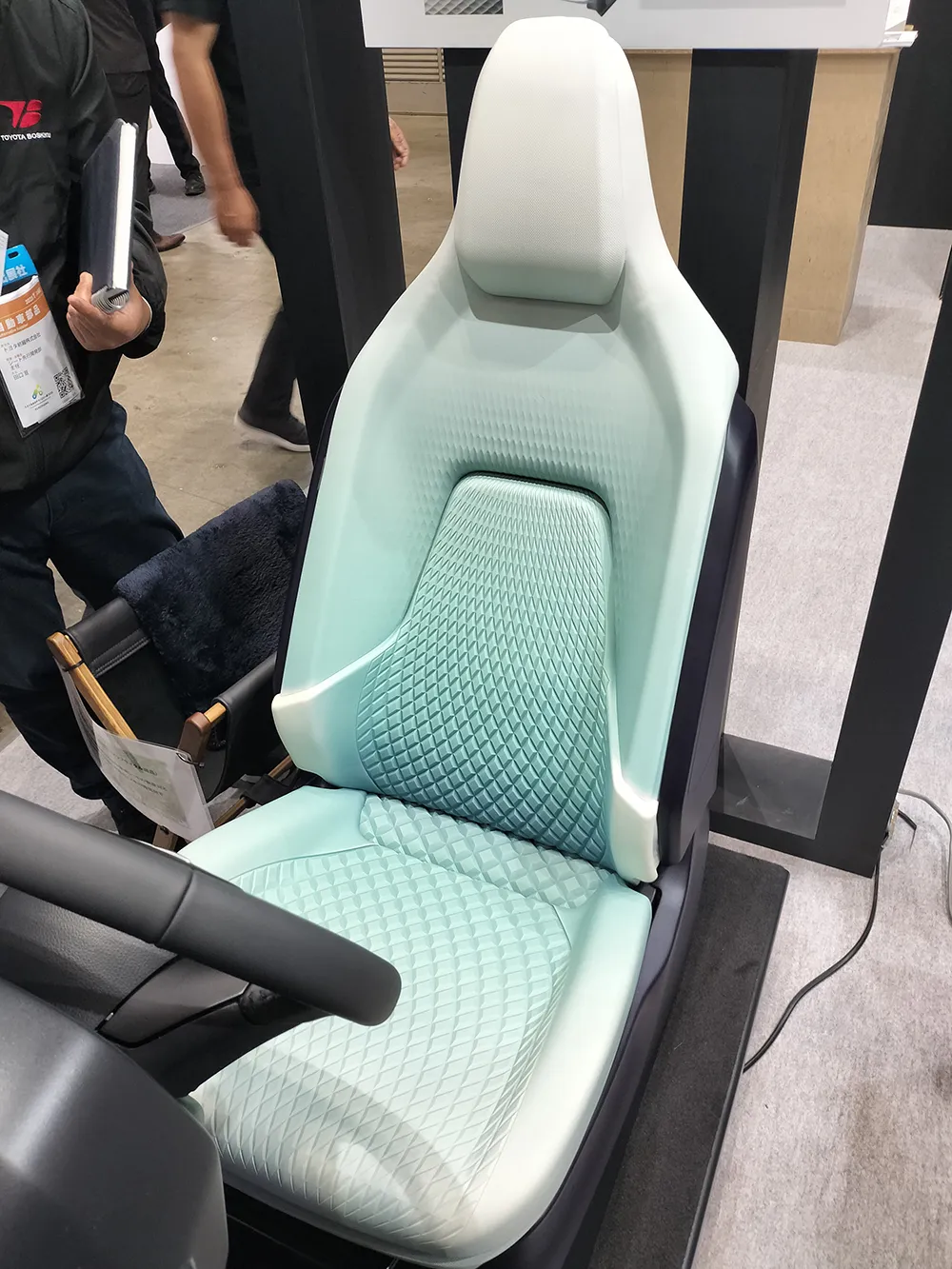
A mono-material car seat cover made of PVC developed by Toyota.
Tier 1 enterprises are also strengthening the development of easy-to-recycle design.
Tier 1 enterprises are also strengthening the development of easy-to-recycle design.
The use of recycled materials and bioplastics in the automotive sector is currently drawing attention. Plastics used in automobiles, such as polypropylene and polyamide, come in various grades. Even for a bumper, a certain car model of Toyota strictly stipulates the compound to be used and its supplier. Therefore, it is always considered extremely difficult to apply recycled materials in the sector. However, since the implementation of the European End-of-Life Vehicle (ELV) regulations which require the adoption of a certain amount of recycled materials in automobiles and part of it be plastics from scrapped vehicles, the whole industry, including automobile manufacturers and Tier 1 enterprises, have given efforts in utilizing recycled materials. This may fundamentally change the material selection process that had always been taken for granted. Of course, OEMs of the automobile sector have set strict specifications for recycled materials, and only use the materials that meet these specifications. On the other hand, as long as the standards are met, it is also possible to open the door to various material manufacturers. The handling of post-consumer recycled (PCR), post-industrial recycled (PIR) and biomass materials has been uncertain since the ELV regulations were proposed in 2023, and it has been difficult for OEMs to clarify their utilization roadmap. However, technology development of PCR, PIR and biomass materials has advanced through collaboration with material manufacturers, the momentum of practical application is steadily increasing. In the future, in order to ensure the supply of PCR materials from scrapped cars, easy-to-disassemble designs of automotive parts will be foreseeable.
Meanwhile, the demand for domestic products in Japan continues to shrink. According to the Japan Plastics Industry Federation, domestic plastics production was 8.396 million tons in 2024, which recorded a year-on-year decrease of 4%. It has decreased by 21% compared with 10 years ago and by 40% compared with 20 years ago, which is significant. This is due to various factors such as the increase of imported products, the hollowing out of downstream products, declining population, and GX initiative (thinning, volume reduction, reuse, etc.).
While plastic exports in Japan have stagnated at a level of less than 4 million tons per year. Imports have steadily increased since 2018, and reached 3 million tons in 2024. The largest imported item is PET, with more than 980,000 tons imported in 2024 and nearly half of them were from Taiwan, region of China. In terms of polypropylene, back 20 years ago in 2004, there were no regions from which Japan imported more than 10,000 tons per year; but by 2014, it imported over 10,000 tons from Thailand, South Korea and Saudi Arabia; by 2024, the United Arab Emirates, Vietnam and China also joined them, bringing the total import volume reached more than 140,000 tons from the 6 regions. In this context, discussions on the restructuring of Japan's aging and less competitive petrochemical complexes continue, and in order to ensure stable procurement, there has been an increased number of plastic processing giants who are considering adopting imported products as a secondary source.

Discussions on the reorganization of petrochemical complexes are ongoing (In the photo: Mizushima Industrial Complex).
With the electrification of automobiles and raising demand for further weight reduction, the application of engineering plastics with better functions like rigidity, strength, insulation, flame retardancy is expanding. Alongside material conversion, the easy disassembly during disposal has also been emphasized and as a crucial factor into design proposals.
CHINAPLAS, which will be held in Shanghai, PR China in April 2026, will feature global plastics and rubber companies, including those from Japan, which will be a valuable opportunity to learn about their latest technologies and development.
About CHINAPLAS 2026
On April 21 to 24, 2026, the industry’s acclaimed trade fair - CHINAPLAS 2026 will take place at National Exhibition and Convention Center (NECC) in Hongqiao, Shanghai, PR China. This edition is expected to bring together more than 4,600 exhibitors and over 320,000 visitors from around the world, providing exceptional opportunities to delve into breakthroughs in intelligent innovations, to build valuable connections and to explore a forward-looking vision of the plastics and rubber industries.
Pre-registration for CHINAPLAS 2026 has begun. Click HERE to pre-register for an admission ticket at USD 7.5. Visitors will receive an eConfirmation letter (Hong Kong/Taiwan/Macau region of China and overseas visitors) upon completion of pre-registration.

Besides the show days, the exhibition also enables buyers to connect with thousands of materials and machines suppliers all year round via CPS+ eMarketplace, a smart, efficient, integrated, and sustainable online sourcing platform which is complementary to the physical show of CHINAPLAS.
For more information, please visit: ChinaplasOnline.com.
On April 21 to 24, 2026, the industry’s acclaimed trade fair - CHINAPLAS 2026 will take place at National Exhibition and Convention Center (NECC) in Hongqiao, Shanghai, PR China. This edition is expected to bring together more than 4,600 exhibitors and over 320,000 visitors from around the world, providing exceptional opportunities to delve into breakthroughs in intelligent innovations, to build valuable connections and to explore a forward-looking vision of the plastics and rubber industries.
Pre-registration for CHINAPLAS 2026 has begun. Click HERE to pre-register for an admission ticket at USD 7.5. Visitors will receive an eConfirmation letter (Hong Kong/Taiwan/Macau region of China and overseas visitors) upon completion of pre-registration.
Scan to pre-register
Besides the show days, the exhibition also enables buyers to connect with thousands of materials and machines suppliers all year round via CPS+ eMarketplace, a smart, efficient, integrated, and sustainable online sourcing platform which is complementary to the physical show of CHINAPLAS.
For more information, please visit: ChinaplasOnline.com.