

Please note that the auto-translation function (beta) uses the 3rd-party tool to translate contents based on the English version of the website and it may occur incorrect results sometimes.
x
2027·4·13 - 16
Shenzhen World Exhibition & Convention Center (Bao'an), PR China

South Korea's Plastics and Rubber Industries Enter a New Era of Transformation

South Korea plastics market end use sectors rPET mandate circular economy plastics chemical recycling smart manufacturing biodegradable materials market outlook
Publish date: 2026-11-26
Quick Overview
1

South Korea's Plastics and Rubber market to grow from USD 14.25 billion (2026) to USD 19.94 billion (2034), a 3.8% CAGR.

2

rPET mandate: 10% recycled PET in qualifying bottles from 2026, 30% by 2030.

3

Packaging (about 42%) and automotive (about 18%) lead plastics demand.

4

Chemical recycling, smart manufacturing and bio-based materials top investment priorities.

South Korea's plastics and rubber industries are entering a decisive period of transformation. Long recognized as a major petrochemical powerhouse in Asia, the country is gradually shifting from a volume-driven production model toward a high-value, sustainability-oriented industrial ecosystem. While demand from traditional end-use sectors remains strong, future growth will increasingly be shaped by engineering plastics, recycling technologies, bio-based materials, and smart manufacturing solutions. The combination of government policy support, technological innovation, and environmental imperatives is driving a comprehensive restructuring of the industry.

South Korean flags. Photo source: Pixabay.com

The South Korean plastics market is forecast to expand from USD 14.25 billion in 2026 to USD 19.94 billion by 2034, representing a CAGR of 3.8%. (Photo source: Pixabay.com)

South Korea plastics market

Market Growth Driven by Strategic Transformation

The South Korean plastics market is forecast to expand from USD 14.25 billion in 2026 to USD 19.94 billion by 2034, representing a CAGR of 3.8%. Meanwhile, the recycled plastics segment is expected to grow at an even faster pace, supported by circular economy policies and rising demand for sustainable materials. Rather than relying on production volume expansion, the industry is focusing on value creation through advanced materials, specialty chemicals, and innovative recycling technologies.

As one of the largest generators of plastic waste on a per-capita basis within the Organisation for Economic Co-operation and Development (OECD), South Korea is under increasing pressure to improve resource efficiency and waste management. In response, the government has established ambitious sustainability targets, creating strong momentum for industry transformation.
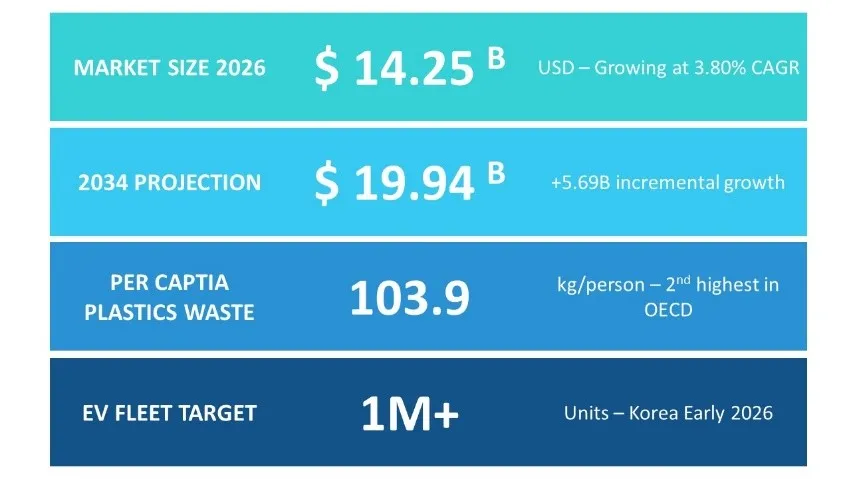
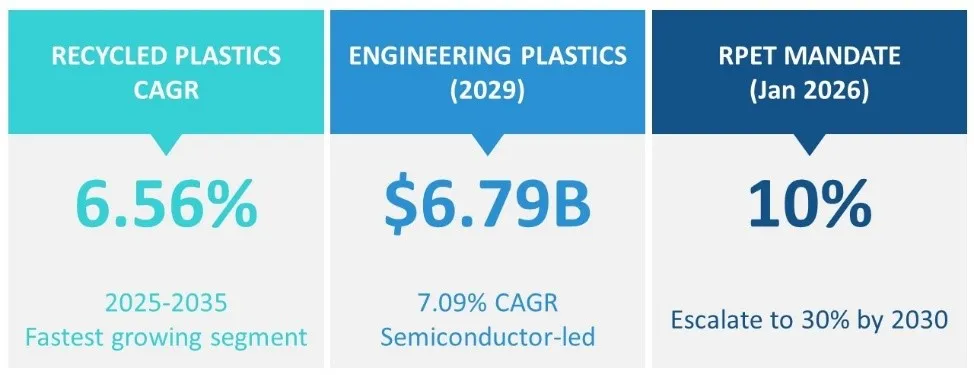
Figure 1: South Korea Plastics Industry Key Metrics Dashboard Figure 1: South Korea Plastics Industry Key Metrics Dashboard

Figure 1: South Korea Plastics Industry Key Metrics Dashboard (Source: Expert Market Research, Ministry of Environment ROK, Mordor Intelligence © 2025-2026)
end use sectors

Packaging Sector Revolution

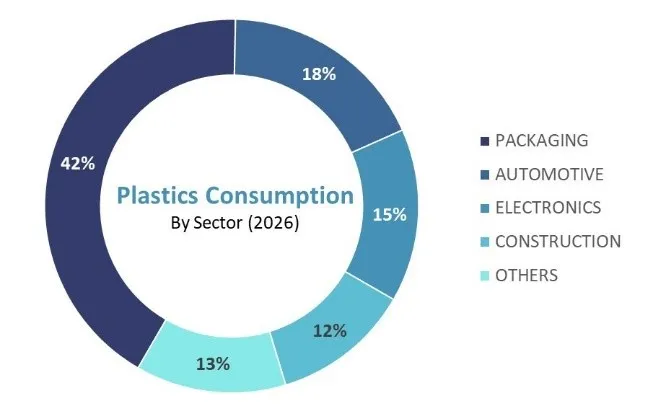
Packaging remains the largest plastics-consuming sector, accounting for approximately 42% of total plastics consumption. The sector is experiencing a major shift following the implementation of landmark label-free packaging regulations.

Beginning in 2026, bottled water products are no longer permitted to use plastic labels, prompting manufacturers to adopt alternative identification methods such as laser engraving, direct printing, and QR-code solutions. These changes improve recycling efficiency while creating demand for advanced coding, marking, and packaging technologies. At the same time, packaging producers are increasingly transitioning from multi-material structures to mono-material designs to improve recyclability and comply with circular economy requirements.

Automotive and Mobility Innovation

The automotive sector accounts for approximately 18% of plastics consumption and continues to be a major growth driver. South Korea's rapid adoption of electric vehicles is generating significant demand for lightweight engineering plastics, advanced battery materials, and specialty polymers.

Applications including battery housings, thermal management systems, sensor-integrated components, and smart mobility solutions require high-performance materials capable of delivering enhanced safety, durability, and efficiency. The expansion of hydrogen infrastructure is also creating opportunities for fluoropolymers, sealing solutions, and advanced rubber materials.

Electronics and Semiconductor Applications

Although the electronics and semiconductor sector consumes a smaller share of overall plastics volume, it generates disproportionately high value due to stringent material performance requirements.

South Korea's leadership in semiconductor manufacturing, artificial intelligence, 5G infrastructure, and advanced electronics continues to drive demand for high-purity polymers, flame-retardant compounds, chemical-resistant materials, and thermally conductive engineering plastics. These high-specification applications are expected to remain a critical growth engine for the country's advanced materials industry.

Figure 2: Plastics consumption by sector (2026)

Figure 2: Plastics consumption by sector (2026) (Source: Expert Market Research, Ministry of Environment ROK, Mordor Intelligence © 2025-2026)

rPET mandate circular economy plastics

Government Policy and Regulatory Framework

Government regulations are playing a central role in accelerating the transition toward a circular plastics economy. Among the most significant measures is the rPET mandate, which requires beverage manufacturers using more than 5,000 tonnes of PET annually to incorporate at least 10% recycled PET into bottles from 2026, with the target increasing to 30% by 2030.

The Korean-Style Eco-Design Framework further encourages recyclable product design by applying economic incentives and penalties based on recyclability performance. Together, these policies are driving substantial investments across the recycling value chain, from collection and sorting infrastructure to advanced food-grade recycling technologies.

chemical recycling smart manufacturing

Technology Solutions and Industry 4.0 Integration

Technology innovation has become a key pillar supporting industry transformation. Manufacturers are increasingly adopting Industry 4.0 technologies such as digital twins, artificial intelligence, machine vision systems, and real-time quality monitoring to improve efficiency and address labor shortages.

Meanwhile, chemical recycling is emerging as one of the industry's most strategic investment areas. Technologies including pyrolysis, depolymerization, glycolysis, and plasma recycling are enabling the conversion of mixed plastic waste into high-quality feedstocks suitable for demanding applications. Major industry players are investing heavily in facilities capable of producing virgin-equivalent recycled materials for food-contact and other high-value applications.

biodegradable materials

Biodegradable Plastics Industry Promotion Act

The introduction of the Biodegradable Plastics Industry Promotion Act represents another important milestone in South Korea's sustainability journey. The legislation establishes a comprehensive framework covering research and development support, industry collaboration, workforce development, certification mechanisms, and government procurement programs.

By fostering innovation in bio-based and biodegradable materials, South Korea aims to strengthen its competitive position in the global sustainable materials market while reducing dependence on conventional fossil-based plastics.

market outlook

Strategic Outlook and Investment Priorities

Looking ahead, several converging trends are expected to sustain industry growth through 2035. Circular economy regulations, electric vehicle adoption, semiconductor expansion, and advancements in recycling technologies will continue to drive demand for high-performance materials, smart manufacturing equipment, and sustainable production solutions.

For machinery suppliers, material producers, and technology providers, South Korea represents one of Asia's most attractive high-value markets. As the country accelerates its transition toward a circular and innovation-driven plastics economy, opportunities for international collaboration and technology exchange are expected to expand significantly. The growing demand for advanced equipment, materials, and solutions has also positioned South Korea as one of the largest sources of overseas visitors to CHINAPLAS, making it an important market for global plastics and rubber industry stakeholders.

Visitor re-registration for CHINAPLAS 2027 is officially open! Pre-register for an admission ticket at the early bird rate of RMB 50 / USD 7.5 (original price: RMB 80 / USD 12).

Source: South Korea's Plastics Industry Comprehensive Industry Report 2026, compiled by Mr. Charles Chong of Platopia for CHINAPLAS. (Read Full Report, English only)

FAQ

South Korea's plastics market is forecast to grow from USD 14.25 billion in 2026 to USD 19.94 billion by 2034, a CAGR of 3.8%, with recycled plastics expanding even faster. Growth is driven by value creation rather than higher volumes: engineering plastics, specialty chemicals and advanced recycling, supported by circular economy policy, electric vehicles and semiconductor demand.

Key measures include the rPET mandate, which requires beverage makers using more than 5,000 tonnes of PET a year to use at least 10% recycled PET in bottles from 2026 and 30% by 2030; the Korean-Style Eco-Design Framework, which rewards recyclable design; the ban on plastic labels for bottled water from 2026; and the Biodegradable Plastics Industry Promotion Act.

Packaging (about 42% of consumption), automotive (about 18%) and electronics and semiconductors offer strong demand for mono-material solutions, coding and marking technologies, high-performance plastics, chemical recycling and smart manufacturing. South Korea is one of the largest sources of overseas visitors to CHINAPLAS. for CHINAPLAS 2027 at the early bird rate of RMB 50 / USD 7.5 (original price: RMB 80 / USD 12).

CHINAPLAS

Pre-register Now to Enjoy the Privileges!

You have entered the 【Beta Version Webpage】 of the CPS+ eMarketplace. If you want to return to the 【Official Version Webpage】, please to proceed. Thank you!

Please select